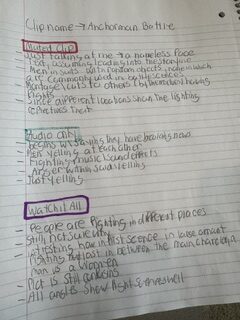
For this assignment, I chose to watch and analyze the clip titled, Anchorman Battle. My first viewing of the clip, on mute, enabled me to appreciate the aspects of the mise-en-scène more. Throughout the entire sequence, I was able to focus on the ridiculousness of the film and how well it was executed across each battle scene to make the chaos feel real. However, without the context behind the motivations of each fight, it was initially confusing to understand the overall plot. This changed when I listened to the audio track alone, allowing me to infer the context and realize that the participants were all male news anchors whose interactions relied entirely on pure yelling and screaming rather than actual dialogue. Lastly, getting to simply watch the clip without any restrictions justified many of my previous observations while making me laugh even more.
Considering all of this, Ebert's ideas surrounding cinematic choices are clearly applied throughout the video. Montages are used as a core editing technique, which contributes heavily to the overall absurdity and continuity of the sequence. The camera framing is used very effectively when transitioning between the different battle scenes because it focuses intently on each individual clash and the specific characters involved. In terms of camera angles, the beginning of the scene is a great example of adding tension; the camera begins by facing two opposing groups and then zooms out to a bird's-eye view to reveal multiple other groups also fighting. Beyond all of this, character placements are utilized perfectly to depict exactly who is fighting whom in a simple, direct manner.
The simplicity behind the techniques applied in this clip adds immensely to the film's comedy because it enables the filmmakers to hide deliberate, strategic cinematic choices behind a chaotic premise. On the surface, this sequence comes off as a collection of random fight scenes with little to no purpose behind the "why" of the battles, especially since each confrontation feels separate. However, that is exactly why the video is so effective; it executes formal cinematic choices while keeping the underlying tone strictly comedic. When combining Ebert's ideologies with my observations from each isolated viewing, you are able to see how the strategic cinematic techniques actually add depth, structure, and comedic relief to the film.